It’s no secret that it’s been a rough year for scientific institutions in the U.S. The National Science Foundation and the National Institutes of Health were vandalized by DOGE and they are still struggling to get back on their feet. Those of us awaiting funding decisions are hearing that a layer of political review seems to have been added on top of the normal review process. Last year, several major universities fell into the crosshairs of the Trump administration, which attempted to coerce their behavior by using the nuclear option of freezing all of these institution’s federal funding–primarily funds for biomedical research. Some universities were also invited by the administration to sign a “compact” that would allow an unprecedented intrusion of the federal government into those institutions’ hiring and curricular decisions.
I don’t want to underestimate the damage that’s been done to research universities in the past year and or minimize the suffering of those whose careers have been affected, but I am optimistic about the future of America’s scientific institutions. In the budget bills passed this week, Congress completely rejected the Trump administration’s proposed draconian cuts to the NIH and NSF. Universities are proving to be resilient, and America’s strong scientific enterprise isn’t something that can be destroyed overnight or even over a year.
But in addition to the more immediate challenges, the scientific community needs to get to work on the longer term problem of rebuilding trust with the broader public. Here I want to suggest that we can rebuild that trust by committing to a successful vision of how the government and universities work together to serve the public.
The vision that we should commit to is not a new one: it is the vision that the U.S. implemented after WWII, leading to our spectacular success in science for over three generations. Most readers have likely heard of Vannevar Bush’s famous report, Science: The Endless Frontier, written for the FDR Administration in early 1945. I imagine that fewer readers have actually read it or know in any detail what its arguments are. Well, I recently reread it and can say that it holds up.
We’re at a moment when the relationship between universities and the federal government seems to be in crisis, and alterante arrangements are being proposed and considered. I’m going to make the case that we don’t need alternatives; we just need to recommit to the principles that Bush laid out 80 years ago.
Before we get to Bush’s specific principles for government support of science, there is one essential prerequisite that Bush, writing as the US was winning a major war, could take for granted, but which we cannot: Government support of scientific institutions must rest on a foundation of broad public legitimacy. Scientific institutions need to maintain the respect and trust of the public that supports them, otherwise they will be seen by many as simply another elite interest group looking for taxpayer dollars. When that happens, Vannevar Bush’s vision for science collapses. I’ll say more on this below, but let’s first dig into the specifics of Bush’s report.
Why should the government fund scientific research?
Science: The Endless Frontier is an answer to the question, why should the government provide stable, long-term funding for basic science? Bush gave four important answers..
1. Basic science is the “seed corn” of technological progress
Whatever you might think of state of the economy today, one of the most important facts about human life in the 21st century is that we enjoy a prosperity that would be envied by nearly everyone alive 100 years ago. The reason for this is long term economic growth, driven by technological progress. Bush recognized that basic research, whose purpose is to generate new scientific knowledge, is the source of scientific capital from which technological progress draws. He called basic research the “seed corn” and “pacemaker” of technological progress. He wrote that
Advances in science, when put to practical use, mean more jobs, higher wages, shorter hours, more abundant crops, more leisure for recreation, for study, for learning how to live without the deadening drudgery that has been the burden of the common man for ages past. Advances in science will also bring higher standards of living, lead to the prevention or cure of diseases, promote conservation of our limited national resources, and assure means of defense against aggression. But to achieve these objectives—to secure a high level of employment, to maintain a position of world leadership—the flow of new scientific knowledge must be both continuous and substantial.
While scientific knowledge and technological progress can benefit the entire world, Bush correctly noted that nations which rely on other societies for scientific knowledge are at a disadvantage. By having scientific institutions here at home, we gain advantages in intellectual property, in human capital, and in the ability for our businesses to act first on new discoveries.
Importantly, it is the role of government to support scientific progress: “Since health, well-being, and security are proper concerns of the government, scientific progress is, and must be, of vital interest to the government.”
2. Scientific progress is critical for the nation’s health, its economic prosperity, and its national security.
Bush noted that major gains in lifespan were due to growth in biomedical knowledge and its application. Not only is a healthier populace a good thing on its own, but a healthier society is also a more economically prosperous one.
The success of our economy also depends in other ways on scientific knowledge:
How will we find ways to make better products at lower cost? The answer is clear. There must be a stream of new scientific knowledge to turn the wheels of private and public enterprise. There must be plenty of men and women trained in science and technology, for upon them depend both the creation of new knowledge and its application to practical purposes.
And finally, Bush noted that one of the most important public goods provided by the government is national defense. Writing in the waning moths of WWII, he said that:
This war emphasizes three facts of supreme importance to national security: (1) Powerful new tactics of defense and offense are developed around new weapons created by scientific and engineering research; (2) the competitive time element in developing those weapons and tactics may be decisive; (3) war is increasingly total war, in which the armed services must be supplemented by the active participation of every element of civilian population.
Today, war is not always total war, but as the war in Ukraine shows, technological innovation is still essential for defending your nation.
3. Progress requires freedom of inquiry
You can’t reliably predict in advance where breakthroughs will happen or what knowledge will prove most valuable:
Many of the most important discoveries have come as a result of experiments undertaken with very different purposes in mind. Statistically it is certain that important and highly useful discoveries will result from some fraction of the undertakings in basic science, but the results of any one particular investigation cannot be predicted with accuracy.
Thus, Bush argued, institutions of scientific research must be committed to freedom of inquiry. Neither politicians nor university administrators should dictate the course of research. Bush thought that universities and research institutes would be optimal sites for basic research because they were committed to open inquiry:
It is chiefly in these institutions that scientists may work in an atmosphere that is relatively free from the adverse pressures of convention, prejudice, or commercial necessity. At their best they provide the scientific worker with a strong sense of solidarity and security, as well as a substantial degree of personal intellectual freedom. All of these factors are of great importance in the development of new knowledge, since much of this new knowledge is certain to arouse opposition because of its tendency to challenge current beliefs or practices.
If universities fail to be places where researchers are free to challenge current beliefs, then they are failing to live up to their part of the bargain that Bush is proposing.
4. Need for a scientific workforce
A trained, talented scientific workforce is the single most important ingredient for scientific progress, and for converting scientific knowledge into technologies that benefit society:
We shall have rapid or slow advance on any scientific frontier depending on the number of highly qualified and trained scientists exploring it.
Critically, Bush argued that the nation needs to draw on talent from anywhere it is found. It is in the government’s interest to ensure that social or economic barriers don’t stand in the way of bringing talented people into science:
Here is a tremendous waste of the greatest resource of a nation—the intelligence of its citizens. If ability, and not the circumstance of family fortune, is made to determine who shall receive higher education in science, then we shall be assured of constantly improving quality at every level of scientific activity.
How to recommit to Bush’s Vision
Bush’s arguments for why the federal government should provide substantial, long-term funding for science are still sound today. To promote the national welfare, the government should support the production of scientific knowledge, at institutions that are committed to free inquiry and to drawing in talent from wherever it is found.
But the obligation doesn’t just go one way, from the government to universities. What Bush is proposing is that universities hold an important public trust. In exchange for public support, universities will work in the broad public interest, and they should be accountable to the public for holding up their end of the bargain. We need to be proactive about communicating to the public that we value this trust, and that we take our obligations seriously. Here are some principles scientists should follow, especially university leaders and those who choose to engage with the public:
Don’t link science with partisan identities. Don’t act like science and universities are the province of political liberals. Science is for everyone, and we should welcome colleagues and trainees regardless of their political affiliation. One way that universities have failed at this is to rely too heavily on language and ideas that come across as partisan. For example, DEI efforts, in principle, align with Bush’s charge to ensure that social and economic barriers don’t keep talented people out of science. In practice, these efforts often rely on tendentious left-wing arguments that have the counterproductive effect of convincing a big chunk of the population that the scientific community doesn’t care about them or share their values.
Hold high standards and aggressively police fraud. The public needs to know that when we spend taxpayer funds, we are doing do with care, and that we take misconduct seriously.
Defend academic freedom from all threats. Elected officials right now represent the most serious threat to academic freedom, but the last decade has seen unacceptable levels of censorship in academia. Too often the problem has been dismissed as minor, affecting only a few people. I do agree that the overwhelming majority of academics have not been affected by censorship, but the problem is real and a dismissive attitude sends the wrong signal to the public. The public needs to know that universities are living up to Bush’s claim that they are committed to free inquiry against all threats.
Be willing to listen to public concerns. Amander Clark, director of the UCLA Center for Reproductive Science, recently wrote in a Nature commentary that
Those of us working in the sector should reflect on the purpose, mission and vision of universities. It’s crucial that educators and researchers listen to the public on whether university visions align with public needs, values and the jobs that will be needed in the future workforce.
National Academy of Science President Marcia McNutt wrote in Science that
The scientific community must also better recognize that it may not be helpful to emphasize consensus in policy reports’ recommendations when the underlying values are not universally shared.
Good doctors learn to communicate effectively with patients by cultivating a bedside manner, which more or less means letting the patient know that you are hearing their concerns. We need to cultivate a similar approach in how we present ourselves to the public–and these days, basically anything we say or do online is public.
Americans understand the importance of science
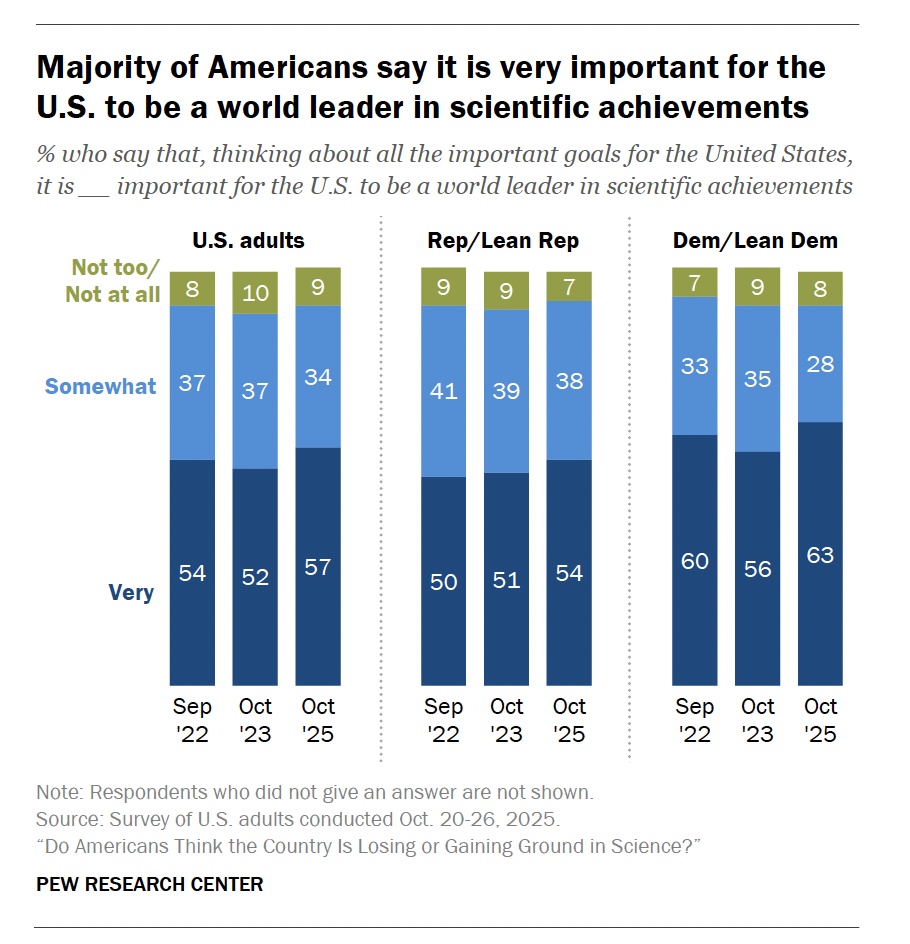
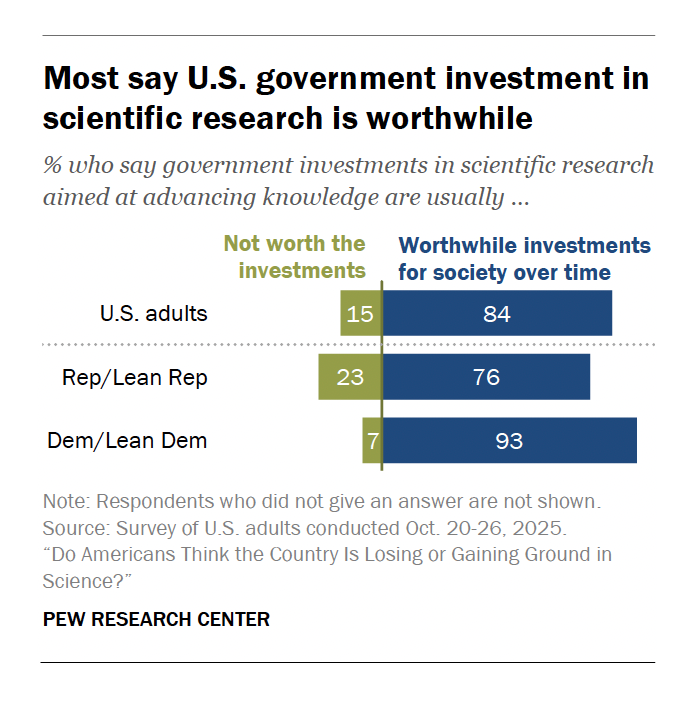
The good news is that Americans across the political spectrum do genuinely understand the importance of science, as recent results from Pew Research show (see below). They don’t need to be convinced of that. Instead, they need to be convinced that scientists and scientific institutions are committed to working in the interests of everyone.